
Shahed-136 and the Geran Family: Variants, Production, Guidance and Employment
Drone Warfare Strategic Assessment
Version 2.0 | Last Updated August 23, 2026 | Strategic Systems Analysis
Bottom Line Up Front
Ukrainian military intelligence assessed in August 2026 that Russia builds roughly 3,000 jet-powered Geran-4 and Geran-5 airframes each month at Yelabuga, and that jet output has passed piston Geran-2 output. That figure comes from one intelligence service and has not been independently confirmed. Public employment data are a separate matter and still show jets at an illustrative 10 to 15 percent of launched Shahed and Geran vehicles, so a production crossover is not yet a fielded one. The piston Shahed-136 that defined this weapon between 2022 and 2025 cruises at about 185 km/h, and by mid-2026 Ukraine was shooting it down with interceptor drones costing a few thousand dollars. The Geran-4 cruises at 400 to 500 km/h, which puts it beyond a tail chase by that interceptor class, though Ukraine reported shooting down or suppressing more than 70 of 76 jet-powered drones in a single daytime attack on 18 August 2026. Ukraine destroyed a record 1,704 Shahed-type drones in January 2026 with roughly 70 percent of the kills made by interceptor drones rather than guns or missiles, and that architecture was built against a 185 km/h target. The cost-exchange position Ukraine spent two years constructing is being contested by a change of engine. A Shahed that struck RAF Akrotiri in Cyprus in March 2026 carried a Kometa-M navigation module, the Russian anti-jam array standard on Gerans over Ukraine. Iran supplied the original design in 2022 and is now importing what Russia did with it.
Report Contents
- Specifications
- Scale of Employment
- The Jet Transition
- Guidance and Communications
- Warheads
- Air-to-Air Configurations
- Production at Alabuga
- Iranian Employment in the Gulf
- Reverse Technology Transfer
- NATO Airspace
- Maritime Employment
- Interceptor Drones and Cost
- Proliferation of the Concept
- Variant Reference
- Assessment
- Sources
Shahed-136 and Geran-2 Specifications
The Shahed-136 is a tailless delta-wing one-way attack drone with a rear-mounted pusher propeller, launched by a discardable rocket booster from a rail or a vehicle-mounted rack. It flies a preprogrammed route to a set of coordinates. That description has held since 2022 and still describes the majority of airframes Russia launches, though it now describes a shrinking share of what Russia builds.1
| Parameter | Value |
|---|---|
| Configuration | Tailless delta wing, rear pusher propeller, rocket-assisted launch from rail or vehicle rack |
| Length, wingspan | ~3.5 m length, ~2.5 m wingspan. Published figures span 3.3 to 3.5 m and 2.5 to 3 m depending on source and configuration. |
| Takeoff weight | ~200 kg class, varying with warhead and fuel load |
| Propulsion | Mado MD-550 four-cylinder piston engine, a copy of the German Limbach L550E. Jet variants use Iranian Tolou-class or Chinese Telefly turbojets. |
| Cruise speed | ~185 km/h for the piston configuration. Geran-4 at 400 to 500 km/h, Geran-5 reported at 450 to 650 km/h. |
| Range | Often reported at 2,000 km or more for the light-warhead piston configuration. Actual radius varies with flight profile, fuel, warhead mass, routing and weather. A 90 kg warhead cuts it toward 1,000 km. |
| Warhead | ~50 kg standard. Russian designs add high-explosive fragmentation, incendiary, shaped charge and thermobaric types, plus a ~90 kg BCh-90 combined-effect warhead. |
| Guidance | Satellite-aided autopilot to preset coordinates. Russian production adds Kometa-series controlled reception pattern antennas, cellular modems, mesh radios, and in some configurations infrared cameras with onboard computing. |
| Radar cross-section | ~0.01 to 0.05 m² X-band, estimated. Honeycomb internal structure and dark surface finishes reduce the signature without making the airframe conventionally stealthy. |
| Unit cost | Commonly estimated at $20,000 to $50,000, with $50,000 to $70,000 cited for late-2025 hardened variants. These figures are estimates. No audited procurement price has been published, and no open-source figure exists at all for the Geran-4 or Geran-5. |
| Operators | Iran, Russia (Geran designations), Houthi forces in Yemen (Waid-1 and Waid-2). Iranian variants have also been reported in Sudan, Ethiopia and Venezuela. |
Figures are current to August 23, 2026. Ranges are preferred to point values where open-source sourcing is genuinely uncertain, and estimates are labeled as such.
A Note on Terminology
Ukrainian daily reporting counts "Shahed-type" UAVs. That category mixes armed Geran strike drones with Gerbera and Parodiya decoys, Italmas, Garpiya and other systems. A reported salvo of 700 Shahed-type drones is not 700 Shahed-136s.
For 2025 the strike share was assessed at about 59 percent, and for July 2026 at about 71 percent. Reading an aggregate figure as an armed-drone count overstates the threat by a third or more, and it is the single most common error in coverage of this weapon.
The Scale of Employment Against Ukraine
A reconstruction of Ukrainian Air Force daily reporting records 54,538 Shahed-type UAV launches against Ukraine during 2025, of which roughly 32,200 were assessed as actual Shahed or Geran strike vehicles. The same dataset records 7,263 vehicles reaching or assessed as hitting their targets.2 The largest single attack of the year came on September 7, with 810 Shahed-type UAVs inside an 823-weapon package. Other large events include 728 on July 9 and 653 on both October 30 and December 6.2
Nightly volumes rose across the same period from fewer than 50 per engagement in the early war to sustained rates above 700, a scaling of ten to fifteen times driven by the industrialization of production and by the specialized Russian strike units built around it.3 Single-event records climbed from 728 drones on July 9, 2025, to between 805 and 823 on September 7, 2025, to 948 across March 23 and 24, 2026. A combined attack on May 13 and 14, 2026 involved approximately 1,567 drones over roughly 38 hours and reached Zakarpattia Oblast on the Hungarian border for the first time.4
The 2026 Monthly Series
Monthly totals through 2026 climbed to a May peak and then fell. The fall is not what it appears to be.
| Month, 2026 | Shahed-type launches | Recorded hits | Reporting quality |
|---|---|---|---|
| January | 4,442 | 649 | Consistent |
| February | 5,059 | 548 | Consistent |
| March | 6,462 | 530 | Consistent |
| April | 6,583 | 609 | Consistent |
| May | 8,161 | 543 | Break from May 5 |
| June | 5,749 | 464 | Night window only |
| July | 4,891 | 479 | Night window only |
From approximately May 5, 2026 the Ukrainian Air Force stopped consistently publishing both the Shahed and Geran count inside the aggregate package and separate quantitative summaries of daytime activity. The June and July figures therefore measure the published night and early-morning reporting windows rather than complete 24-hour employment. Applying the official monthly interception total of 5,142 as a constraint produces an analytical estimate of roughly 5,700 to 5,858 Shahed-type UAVs for July, which is a modeled scenario rather than an observation.4
An independently compiled open-source reconstruction counted 5,078 for July, within 3.8 percent of the Air Force morning-report figure, which supports the baseline as reproducible without establishing that either count captures a full day.4 The July strike share was revised upward to 71.1 percent, derived from 3,656 Shahed-131, 136 and 238 UAVs reported destroyed against 5,142 intercepted UAVs of all types.4
Analytical Consequence
Production cannot be inferred from launch counts after May 2026. The published series fell 40 percent from May to July while the reporting scope narrowed. Employment also need not equal contemporaneous factory output, because launches draw on stockpiles and the subtype mix changed.
The pattern change within the windows holds regardless. No published July reporting window exceeded 500 UAVs, against repeated periods of 600 to more than 900 in March through May. Sixteen of 31 July days came in below 140. The very large concentrated night packages became much less common even if daytime launches are added later.
Distribution Across the Day
Through 2026 the timing of attacks became as important as their size. Russia moved toward cycles running 24 to 32 hours, mixing smaller night packages with daytime activity and a larger role for missiles and faster jet variants.4 Ukrainian reporting on June 20, 2026 described more than 200 drones arriving from morning through the working day.
A defense built for a nightly wave absorbs this badly. Crews lose the recovery interval between alert periods. Mobile interceptor teams that could stand down at dawn now cover daylight hours. Aviation deconflicts with friendly drones and ground-based air defense for longer stretches. Energy and transport facilities sustain repeated disruption rather than preparing for one predictable window.
Civilian Effects
The UN Human Rights Monitoring Mission in Ukraine verified 2,514 civilians killed and 12,142 injured during 2025, 31 percent above 2024 and the deadliest year since 2022. Long-range weapons, meaning missiles and loitering munitions, accounted for 682 of those deaths and 4,443 of the injuries, a 65 percent rise over the previous year.5 The combined strike on Ternopil on November 19, 2025 killed at least 38 civilians including eight children, the deadliest single verified incident in more than two years; the Air Force reported 476 drones and 48 missiles that night.6
The pattern continued into the reporting period's final week. A Russian strike drone hit a shopping center in Kryvyi Rih in daylight on August 21, 2026, killing at least 16 people and injuring 130 including 23 children. A second drone struck roughly half an hour later, when rescue services were already working the site, in a sequence President Zelensky described as a deliberate double-tap aimed at emergency responders. The strike fell inside nearly 60 attacks across four districts of Dnipropetrovsk Oblast that day.7, 8, 9
Two features separate this from earlier Shahed strikes on civilian targets. The timing was daylight, consistent with the shift toward attack cycles distributed across the day. And the half-hour interval is consistent with deliberate sequencing, which uses a cheap expendable munition as a sequenced tactical weapon rather than as an area terror instrument. A preset delay would produce the same interval, so the timing alone does not establish that the second drone was launched on observation of responders arriving. Ukrainian reporting attributed the strike to a jet-powered Geran-4, while other accounts identified a Shahed-136; the attribution is unresolved in public sources and does not affect the tactical point.
The winter campaign of 2025 into 2026 concentrated on the energy grid during peak demand, with eight major coordinated waves against power infrastructure in October and November 2025 alone, alongside sustained attacks on ports at Odesa, gas infrastructure, defense industry and cities.6
The Jet Transition: Geran-3, Geran-4 and Geran-5
Ukrainian military intelligence assessed on August 12, 2026 that Russia produces approximately 3,000 Geran-4 and Geran-5 airframes per month, and that jet production has surpassed piston Geran-2 production. Serial production is concentrated at Yelabuga inside the Alabuga Special Economic Zone, and satellite imagery from early July 2026 shows large-scale new construction intended to expand capacity further.10, 11
That figure originates with one intelligence service and is reproduced across several outlets, so it carries the confidence of a single well-placed source rather than of independent corroboration. Employment data tell a more restrained story than the production figure. Jet-powered Geran launches rose from approximately 180 across all of 2025 to approximately 1,400 in the first half of 2026, and the jet share of Shahed and Geran totals is treated in the monthly analysis as an illustrative 10 to 15 percent range, with an explicit warning that public subtype data are insufficient to calculate a reliable figure.4, 12 Production share and employment share are different quantities, and the gap between them is where a stockpile is accumulating.
Geran-3
The Geran-3 is a localized derivative of the Iranian jet-powered Shahed-238, using a Tolou-class turbojet. Ukrainian Defence Intelligence reported in February 2025 that Russia was establishing domestic production. Claimed performance runs to 550 or 600 km/h, but recovered units cruised nearer 300 to 370 km/h because of fuel limits, and a May 2026 Ukrainian breakdown found the type reused the propeller-era airframe, which was poorly suited to sustained high-speed flight. It was largely phased out of production by mid-2026 as lines reconfigured.12
Even at the lower observed speeds the Geran-3 cut transit from the Belarusian border to Kyiv to roughly 35 minutes. Its larger airframe and exhaust plume produce a bigger radar return and a strong thermal signature, and Ukraine now tracks it by that signature. The type became easier to see and harder to reach at the same time.12
Geran-4
The Geran-4 entered combat use around May 2026 after mass-production preparation completed in January. It has a reinforced airframe, described in some reporting as one-piece rather than the earlier detachable-wing transport arrangement, and is powered by Chinese Telefly turbojets: the LX-WP-160 at roughly 160 kgf, reported as discontinued, and the TF-TJ2000A at roughly 200 kgf. Assessed speeds run from 350 to 500 km/h with dashes toward the upper figure. Range figures vary from about 450 km to about 850 km, ceiling to roughly 4,000 to 5,000 m, endurance around two to two and a half hours, and takeoff weight rising toward 350 to 450 kg. Warheads stay in the 50 kg class with 90 kg options reported. Full performance treatment is at Geran-4.10, 12
The timing is the finding. Ukrainian interceptor drones reached roughly 50 percent kill rates against the Geran-2 by mid-2026, up from about 10 percent in the winter of 2025 into 2026. The Geran-4 entered service against that improvement, and the two curves cross in the same quarter.12
Geran-5
First observed in combat around January 2026, the Geran-5 abandons the delta planform for a conventional cruise-missile fuselage, with reporting linking the layout to Iranian Karrar influence. Published figures give roughly 6 m length and 5.5 m wingspan, a 90 kg payload, 900 to 1,000 km range, and 450 to 650 km/h on a Chinese turbojet, with air-launch from Su-25 aircraft reported. That combination sits closer to a low-cost cruise missile than to a loitering munition.10
Russia extended its launch infrastructure to match. Extended rails of roughly 280 feet were built at Tsymbulova in Oryol Oblast in late 2025 to accommodate the heavier takeoff weight and higher stall speed, and by mid-2026 that site featured 16 heavy launch positions supported by storage buildings holding more than 1,000 drones.13
Effects of the Speed Increase
A Geran-2 at 185 km/h can be run down from behind by a 343 km/h interceptor quadcopter. That margin is what made the architecture work. A Geran-4 at 400 to 500 km/h cannot be caught in a tail chase by anything in that class, so every engagement has to be cued forward of the target and flown as a collision geometry rather than a pursuit. The interceptor needs earlier detection, a longer-ranged datalink, and enough speed margin to reach a point the target has not yet arrived at. The jet is not harder to detect at any given instant, and its larger radar return and hot exhaust plume arguably make it easier. What compresses is the usable timeline, because warning, identification, decision and launch all have to happen in a fraction of the time, and a forward intercept raises the accuracy demanded of the cue.
Altitude compounds it. A jet Geran cruising at 4,000 to 5,000 m sits above the reach of the mobile gun groups that Ukraine built into a cheap and effective layer, and above most improvised kinetic answers. Acoustic detection, which gave useful warning against the distinctive piston note, loses most of its value when the sound arrives with the weapon.
Speed also opened target sets that a 185 km/h drone could not hold. A Geran-4 destroyed a Ukrainian MiG-29 at a southern airfield on June 27, 2026 during pre-mission preparation. On August 13, 2026 a jet-powered variant struck the locomotive of a moving passenger train in Odesa Oblast, killing two crew, inside a campaign that damaged or destroyed more than 200 locomotives in the first half of the year.12
The propulsion trend runs below the Geran family as well. A jet-retrofitted BM-35 reached more than 350 km/h and more than 200 km range with a 10 kg warhead in August 2026, explicitly to outrun Ukrainian interceptors.12 Iran took the opposite path on a parallel line: the updated Shahed-101 fielded in March 2026 uses nose-mounted electric propulsion with a detachable rocket booster, trading thrust and range for acoustic and infrared signature reduction. One airframe lineage is producing two incompatible answers to the same countermeasure problem, and which one is correct depends on whether the defender's binding constraint is detection or interception.
Guidance and Communications
The original Shahed-136 was a coordinate-seeking munition. Its autopilot followed waypoints on satellite navigation and required no continuous operator link, which made it cheap and largely immune to loss of communications while ruling out dynamic retargeting. Successive Russian modifications reduced its dependence on easily disrupted civilian satellite reception and on any single communications path. Kometa is itself a satellite navigation system, and cellular, mesh and satellite datalinks are all radio frequency communications, so the architecture became redundant rather than independent of either. Each step removed a defensive method that had been working on its own.1
Anti-Jam Navigation
Early Iranian airframes used a commercial inertial navigation system augmented by civilian GPS, and Ukraine's Pokrova network had real success spoofing them off course. Russian production replaced that arrangement with GLONASS-capable Kometa-series controlled reception pattern antennas. Ukrainian Defence Intelligence reported an eight-channel array in early 2025, labeled in Chinese and English as agricultural equipment parts, followed by 12-element Kometa units, with 16-element arrays reported since.14
A controlled reception pattern antenna does not defeat electronic warfare. It nulls interference by antenna geometry rather than by filtering, which raises the power, the geometry and the sophistication a jammer needs to produce a useful navigation error. Against a fixed ground-based jammer covering a predictable corridor, the effect is close to immunity. Against a jammer positioned to exploit the array's geometry, it is not. The practical result was that jamming stopped being a reliable first answer and became one contribution among several.1 The non-kinetic defeat page covers the jamming side of this exchange in detail.
Cameras and Onboard Computing
Ukrainian Defence Intelligence documented a Shahed-136 or Geran-2 configuration designated MS001 containing an analog infrared video camera and a USB 3.0 video capture unit. Recovered airframes have carried Nvidia Jetson modules, Raspberry Pi boards, webcams, and cellular modems. A Ukrainian electronic warfare specialist reported the first recorded use of video-guided Shaheds at ranges of at least 150 km inside Ukraine.4
These are component observations from wreckage, and the inference they support is narrower than the coverage suggests. A camera and a video digitization chain can serve terminal imagery, navigation assistance, target confirmation, mission recording, or a remote operator. None of those requires autonomous target recognition, and the presence of a capable processor does not establish what software runs on it. Descriptions of every new Shahed as AI-controlled outrun the evidence. What the hardware does establish is that Russia and Iran fielded sensor-equipped configurations that depart from the original coordinate-only architecture, and that some of those configurations reached serial production rather than remaining prototypes.1
The Belarus Relay Network
Russia routed Shahed strike coordination through Belarusian civilian 4G and LTE cell towers, supplemented by ground-based repeaters and, from May 2026, airborne signal-relay balloons launched from Belarusian territory. The network extended guidance and telemetry into Kyiv, Rivne and Volyn oblasts using infrastructure that is hard to attribute and harder to sanction, since the towers serve civilian subscribers.15
Ukrainian specialists sustained covert access to Russian strike coordination communications for roughly six months by exploiting that same commercial infrastructure, giving visibility into launch orders, flight routing and operator coordination.16 In late February 2026 Ukraine struck the relay infrastructure directly and neutralized three or four nodes.15, 17 The episode illustrates the structural cost of building a weapon's command network on civilian infrastructure: the same properties that make it hard to attack make it hard to secure.
Satellite Links
Russian drone units began integrating Starlink terminals into Molniya strike drones in December 2025, with Shaheds following shortly after. Satellite links operating at 11 to 20 GHz sit outside the frequencies Ukrainian electronic warfare was built to contest. A satellite-linked Shahed can change course in flight, loiter over an area, and select its target in real time, which converts a preprogrammed munition into a supervised one.18
Ukraine's answer was a whitelist and geofencing arrangement agreed with SpaceX, with daily terminal registration mandated inside Ukraine.19, 20 Ukrainian officials subsequently reported the Shahed and Geran interception rate rising from 83 to 91 percent.18
Sequencing Correction
Ukrainian interception of Shahed-type drones fell from 96.58 percent in January 2025 to 82.7 percent in December 2025, and the decline is widely attributed to Starlink. Serial integration across Molniya and Shahed strike drones is dated to December 2025, after almost the whole of the fall.18
Chronology does not settle it. Defense Express documented a Starlink terminal on a downed Shahed-136 after the attack of 24 to 25 September 2024, more than a year earlier.21 One recovery establishes that the fit existed and says nothing about how many airframes carried it, so early limited use can be neither excluded nor scaled. Rising launch volume, Kometa navigation hardening, the cellular relay network and tactical change are all plausible contributors to the 2025 decline. Apportioning it among them needs prevalence and timing evidence that is not public.
Mesh Radio and Institutionalized Cellular Telemetry
Chinese XK-F358 and HX-50 class mesh modems have appeared in Geran and Gerbera airframes since July 2025, supporting self-healing mesh communications that survive heavy node loss across 100 to 600 km. The modem remained unsanctioned as of August 2026.18 Ukraine confirmed in April 2026 that Russia places bulk state orders for Rostelecom subsidiary SIM cards supplied directly to Shahed manufacturers for every unit, which makes cellular telemetry a standard redundancy layer rather than an experimental fit.18
In July 2026 Russia merged Molniya loitering munitions and Gerbera decoys onto a single self-healing mesh network sharing one Chinese modem and frequency band, extending operator control range for the Molniya through Gerbera relay nodes. Ukraine identified the Gerbera node as the exploitable point of failure in that architecture. Each layer of redundancy Russia adds creates a new dependency for Ukraine to attack.18
Warheads and Payload Configurations
Weapons exploitation documents Russian Shahed-136 and Geran-2 warheads in high-explosive fragmentation, incendiary, shaped-charge and thermobaric types. The standard payload is about 50 kg, and documented Russian designs include the TBBCh-50M thermobaric warhead. Fragmentation liners have been packed with tungsten balls to maximize anti-personnel effect against mobile air defense teams, producing lethal fragmentation beyond 50 m.1, 14
The roughly 90 kg BCh-90 is a combined-effect design pairing a shaped-charge liner with fragmentation and zirconium-based incendiary effect. Iranian and Russian variants of the 90 kg class have both been documented.22 Leaked planning documents referenced orders on the order of thousands of thermobaric and high-explosive-incendiary 50 kg warheads, though the provenance of those documents cannot be independently verified and the figures should be read accordingly.
Accommodating the 90 kg warhead requires displacing fuel, which cuts maximum range from roughly 2,500 km toward roughly 1,000 km. A 2,000 km range and a 90 kg warhead are two points on a trade-off curve rather than simultaneous performance characteristics, and quoting both in one specification line describes an aircraft that does not exist. Russian command evidently judged the trade favorable, because 1,000 km still reaches western Ukraine while the heavier payload substantially raises the probability of destroying a substation or a compressor station on a single hit.1
Modularity is the operative consequence for a defender. A thermobaric payload increases effect inside buildings and enclosed spaces. An incendiary component complicates firefighting and recovery. A heavier shaped-charge configuration buys localized penetration at the cost of reach. None of this is visible from outside the airframe, so the damage mechanism cannot be inferred from the radar track or from wreckage photographs of the planform.1
Structural adaptations follow the same logic of small changes with disproportionate defensive cost. Reported modifications include armor plating around the engine compartment, relocation of fuel tanks from the wings into the fuselage so that an interceptor must strike a critical area rather than merely damaging a wing, matte-black coatings that reduce radar return and make night visual acquisition harder, and internal rearrangement to fit heavier warheads or additional electronics. Some airframes have carried anti-tank mines under the wings, and some have acted as motherships releasing smaller drones over the target area.14
Air-to-Air Geran Configurations
On December 15, 2025 Ukrainian Defence Intelligence published hardware recovered from a Geran-2 configured to carry an R-60 air-to-air missile on an aviation launch rail, together with a missile control unit and satellite navigation electronics. A separate configuration published in January 2026 carries a Verba man-portable air defense missile with a Raspberry Pi 4, a cellular modem and a tracker, and reporting also describes Igla-S mounts. Recovered examples show altered fuselage and fuel-tank layout to accommodate the launcher.23
The armed configuration uses two cameras, one in the nose and one near the missile mount, and a mesh modem to feed imagery to an operator who launches against a detected interceptor aircraft or helicopter. The R-60 then homes independently on infrared out to an estimated 7 to 8 km.23
The purpose is legible from the target set. Helicopters and light aircraft had become an effective and comparatively cheap way to hunt slow Gerans, and an armed Geran embedded in a strike package forces every crew to treat each slow radar track as a possible shooter. That changes the standoff distance a pilot is willing to accept even if the missile never fires. That is the cheaper half of the effect.
Two limits belong beside that. No public evidence establishes that an armed Geran has shot down a Ukrainian aircraft or interceptor drone, so engagement envelope, sensor quality and kill probability are all unestablished. And the configuration costs the airframe its primary role: a MANPADS-equipped Geran-2 gives up its warhead entirely and drops effective range from roughly 2,500 km to roughly 2,000 km. Russia is spending a strike sortie to threaten a defensive one.23
The Depleted Uranium Finding
The Security Service of Ukraine recorded a gamma radiation level of 12 microsieverts per hour on the wreckage of an R-60 missile mounted on a modified Geran-2 used against Chernihiv Oblast on the night of April 7, 2026, with fragments recovered near the village of Kamka. Investigation identified depleted uranium, uranium-235 and uranium-238, in the warhead. The baseline R-60 uses tungsten alloy fragmentation elements; the R-60M variant introduced rod elements of depleted uranium. The warhead was made safe and moved to radioactive waste storage, and criminal proceedings were opened.24, 25, 26
That recovery is no longer the only case. On 23 July 2026 the Security Service reported six further instances of Geran-2 drones carrying R-60M missiles adapted for drone use, from strikes on Chernihiv Oblast between April and June 2026. Gamma readings on individual fragments ran from 8.3 to 24 microsieverts per hour against a sanitary norm of 0.3, and uranium-235 and uranium-238 were identified again.27, 28 Seven documented cases across three months make this a recurring fielded configuration rather than a single anomaly. What share of the fleet carries it is still unknown.
Operational Implications
The novelty is the delivery system. The R-60M carries depleted uranium in a continuous-rod warhead as a standard Soviet design feature, chosen for the density that cuts airframes rather than for any radiological effect. A mass-produced expendable drone carrying it into urban airspace is, because the airframe is expected to come down and the missile is expected to come down with it.
Recovery crews inherit the cost. A wreckage site becomes a contamination survey before it becomes an exploitation opportunity, which adds equipment, training and time to every recovery of this configuration, and slows the intelligence cycle that recovery feeds.
A further defensive adaptation runs alongside. From May 2026 Russia fielded Shahed variants with rear-mounted frequency-suppression jammers aimed at the command-link frequencies of Ukrainian interceptor drones, with Ukrainian officials describing effectiveness as mixed.18 The result matters less than the target. Russia is now spending payload, weight and range on a drone to defend itself against a several-thousand-dollar quadcopter, which is a measure of how well that quadcopter was working.
Production at Alabuga
Satellite analysis assessed in March 2026 that since late 2021 the UAV factory and its associated facility area at the Yelabuga Special Economic Zone had expanded from two buildings under construction to a 17-facility complex of as many as 116 buildings across more than 2,820,000 square meters, with 67 finished housing units able to accommodate roughly 20,000 workers. Construction of two large housing projects began 1.5 km west and west-southwest of the factory in February and March 2025, potentially comprising up to 56 and 22 multistory buildings.29, 30
An independent imagery assessment from July 2025 documented hundreds of new residential buildings, twelve new production, workshop, warehouse or office facilities, and a temporary tent city of 119 tents, with housing under construction that could eventually hold roughly 41,000 people.31 The site sits roughly 1,000 to 1,100 km east of the Ukrainian border with rail access, which places it beyond the reach of most Ukrainian strike systems and gives it a logistics position no plant near the front could match.29
Production Volume Evidence
Three categories of production evidence exist for this facility and they answer different questions.
Three Kinds of Production Evidence
- Manufacturer statements. The Alabuga director said in July 2025 that the plant was producing nine times more Gerans than originally planned and called it the world's largest strike drone factory. He disclosed no auditable total and no precise baseline, so the multiple cannot be resolved into a number.
- Satellite imagery. Establishes investment, floor area, housing, storage and security. It cannot count completed airframes leaving an assembly line, and a building whose function is unconfirmed cannot be assigned to Shahed production.
- Expenditure. Roughly 32,200 Shahed or Geran strike vehicles launched in 2025 implies a very large supply base. It does not measure annual output, because launches draw on stockpiles, imported components, earlier production and plants other than Alabuga.
Working from two readings of the nine-times claim produces illustrative annualized figures of about 18,540 and 24,640 Shahed-136 units, published with an explicit warning that the director was probably exaggerating and that actual production was likely lower than even the smaller value.31 Reports cited in March 2026 of broader Yelabuga drone output above 5,500 units per month span multiple UAV categories at an increasingly diversified complex and cannot be read as 5,500 Shahed-136s.29
Every production number in circulation for this weapon is a scenario bound built on a manufacturer claim or a category-spanning report. The honest range is wide, and the 3,000 jet airframes per month figure from Ukrainian intelligence should be held to the same standard as the ones that preceded it.
Labor
The Alabuga Start program recruited young women aged 18 to 22 from Africa, Latin America and South Asia under misleading promises of hospitality, catering or study placements, with most reportedly assigned to drone assembly under long hours, surveillance and exposure to caustic chemicals. The Global Initiative Against Transnational Organized Crime estimated around 800 women from 27 countries had participated, roughly 90 percent placed in drone assembly. Interpol opened a human trafficking investigation reported in April 2025. The facility also drew on students from the local polytechnic college, including minors. On 5 May 2026 the United Kingdom designated 35 individuals and entities in a single package, 18 under its Russia sanctions regime and 17 under the Global Irregular Migration and Trafficking in Persons Regulations 2025. Seven of the Russia-regime designations, six people and the company Enangue Holding, were named for recruitment on behalf of Alabuga Start specifically.32
Ukrainian intelligence reported in July 2026 that Alabuga workers, including minors, had been moved to operate Geran and Gerbera-Seeker control points inside the reactor complex of the occupied Zaporizhzhia nuclear plant, siting drone operations where an opponent is least willing to strike.4
Components and the Limits of Sanctions
Technical exploitation consistently finds foreign-origin electronics: Texas Instruments processors, Xilinx and Altera programmable logic, Analog Devices radio-frequency parts, Microchip and STMicroelectronics components, u-blox satellite navigation receivers and Nvidia computing modules. Ukrainian foreign intelligence assessed that as of early 2025 about 80 percent of critical electronics for Russian drones originated in China. Investigative reporting traced 672 shipments of sanctioned EU-firm components to Russia between January 2024 and March 2025 through 178 intermediary companies, mostly in China and Hong Kong, with no evidence that the original manufacturers exported directly to Russia.
The engine line shows the structural problem clearly. The Mado MD-550 is a copy of the German Limbach L550E. In 2017 a Chinese corporate network acquired Limbach Flugmotoren and began producing the engines through Xiamen Limbach. After Xiamen Limbach was sanctioned in 2024 for supplying Russia, the network changed its corporate facade rather than its business: by early 2026 a newly established front company operating from a laboratory affiliated with a Chinese technical university was sending automated marketing solicitations for L550 engines to Iranian and Russian buyers. Challenged about the emails, representatives said the software had generated them without human direction.33
United States Treasury designations continued through the period. A November 2025 action sanctioned 32 individuals and entities across Iran, the United Arab Emirates, Turkey, China, Hong Kong, India, Germany and Ukraine supporting Iranian missile and drone networks, identifying Mado as a producer of the engines used in the Shahed-131 and Shahed-136. In April 2026 Treasury stated that an Iranian electronics company had procured thousands of servomotors with one-way attack drone applications, components of the type recovered from downed Shahed-136s.33
Blocking a part number invites substitution. Blocking a functional category is much harder, because satellite navigation receivers, microcontrollers, servomotors, cellular modems and video processing boards all have large legitimate civilian markets. Enforcement that works has to combine customs data, financial intelligence, distributor diligence and battlefield exploitation quickly enough to identify the replacement network before it matures, which is a higher operational tempo than sanctions regimes were designed for.
Ukraine has attacked the same problem kinetically. It sank the Port Olya-4 cargo vessel in the Caspian Sea on August 16, 2025, more than 400 miles from Ukrainian territory, targeting Shahed components and Iranian ammunition moving along the supply route.34 On June 10, 2026 an FP-5 Flamingo struck the VNIIR-Progress plant in Cheboksary, which manufactures the Kometa-series antennas used across Shahed, Iskander-K, guided bomb and Orlan platforms.4 Both strikes hit specialized inputs rather than final assembly. Inputs are the harder thing to replace. No public evidence establishes a resulting fall in Alabuga output, and after the May reporting break the launch statistics can no longer be used to look for one.

Iranian Employment in the Gulf
Following United States and Israeli strikes on Iran beginning February 28, 2026, Iran fired more than 1,000 drones toward Israel and Gulf states in the first week, in volume attacks intended to overload defenses. The Shahed-136 sits at the center of that architecture, though public information does not provide a reliable breakdown between the Shahed-136, other Shahed family types, and additional Iranian designs.35, 36 Iran's full inventory and employment doctrine are treated separately at Iran Drone TTPs and Hardware Catalog.
By March 2 the UAE Ministry of Defence reported 689 Iranian drones detected, 645 intercepted, and 44 reaching UAE territory or waters, an interception ratio of about 93.6 percent. Bahrain reported cumulative interception of 233 drones and 129 ballistic missiles by March 17. Qatar announced interceptions repeatedly through the same month.37
Reconciling Two Figure Sets
Two sets of numbers circulate for the opening days and describe different scopes. Initial regional reporting cited 576 incoming drones with 541 intercepted. UAE government figures for the same period gave 209 detected, 195 intercepted and 14 falling in UAE territory, alongside 137 ballistic missiles detected.
The larger set describes estimated multi-state attack volume; the smaller describes UAE-directed drones only. The later UAE cumulative figure of 689 supersedes the 209 snapshot rather than contradicting it. Both scopes support the same conclusion about saturation. The discrepancy has propagated because nothing turned on resolving it.37
Kuwait International Airport
Iran conducted a series of attacks on Kuwait International Airport beginning February 28, 2026, targeting Terminal 1 and air traffic control infrastructure. Closed-circuit footage from several angles captured a low-flying drone striking the passenger terminal, and weapons analysts assessed the airframe as consistent with a Shahed-136. Exploitation of the incident cites both the airframe profile and recovered Mado MD-550 engine evidence. Commercial aviation in Kuwaiti airspace was suspended, and Kuwait took the case to the International Civil Aviation Organization.38, 1
An IRGC spokesman denied that Iran targeted the airport and attributed the damage to a Patriot interceptor falling on the terminal after a failed engagement. Analysts noted that the trajectory and characteristics visible in the released footage are inconsistent with a falling interceptor. Both the denial and the footage belong in the record, and the contradiction between them is itself the finding: Iran was willing to conduct the strike and unwilling to own it.38
Striking civilian aviation infrastructure in a nominally neutral Gulf state departs from prior Iranian targeting, which concentrated on Israeli, Saudi and United States-affiliated military objectives. The intensity was calibrated below what the target could have absorbed, which is consistent with coercive signaling rather than maximum damage, and consistent with an intent to demonstrate reach without unifying the Gulf states against Tehran.
Sensor Targeting and United States Losses
Iran struck radar installations at Naval Support Activity Bahrain, the operational headquarters of the United States Fifth Fleet, with Shahed drones on February 28, 2026, flying a low-altitude profile to exploit gaps in radar coverage. Attacking the sensors first is consistent with degrading a defensive architecture before follow-on operations, though the available evidence does not separate deliberate sequencing from opportunistic targeting of a high-value installation.39
An E-3 Sentry airborne warning and control aircraft was destroyed on the ground at Prince Sultan Air Base on 27 March 2026 in a combined attack using six ballistic missiles and 29 armed drones, the first combat loss of the type in 47 years.40 An F-15E was shot down over Iran on 3 April 2026, the first United States combat aircraft lost to enemy fire in more than two decades; both crew were recovered alive, one that day and the second on 5 April.41, 42 A crew member described a layered, interconnected drone formation, an account that has not been corroborated by forensic or signals intelligence and for which a dense barrage of Product-358 munitions remains an alternative explanation.43
The institutional response followed. In late June 2026 the Air Force moved to create a dedicated specialty code for air base defense and to stand up point defense flights at selected installations, after damage to air bases across the region during Operation Epic Fury exposed a personnel gap.44
Interceptor Expenditure
The Gulf coalition expended more than 1,000 Patriot interceptors in the first ten days of the conflict against regional stockpiles assessed at 1,800 to 2,300 missiles. THAAD interceptors, at $12 million to $13 million each, were consumed within the first fortnight at a rate absorbing a large share of a production line running at 96 per year, and the United States redeployed interceptors from South Korea to hold supply. Ukrainian advisers deployed to the region described Gulf air defenses in the opening days as firing without classifying threats or rationing interceptors, putting multiples of their most capable missiles onto drones.45 Ukraine, on a separate accounting, expended about 700 PAC-3 interceptors across four winter months of 2025 and 2026 against a production rate near 600 per year.46
The decisive quantity in those figures is not the price ratio. It is the production rate set against the expenditure rate, because that ratio determines how many days a defense can be sustained rather than how much it costs. A magazine consumed four times faster than it refills fails on a schedule that can be calculated in advance, and an attacker who can count public production figures can calculate it too.
Reverse Technology Transfer
A drone strike on RAF Akrotiri in Cyprus in early March 2026 left debris from which investigators recovered a Kometa-M satellite navigation module, a Russian-designed controlled reception pattern antenna array that is standard equipment on Russian Geran drones over Ukraine. British military intelligence extracted the hardware and sent it to a laboratory in the United Kingdom for analysis.47, 48, 49
The module's Russian lineage is established independently of the Cyprus recovery. Ukrainian intelligence documented the Kometa in the Geran-3 in September 2025 and a Kometa-M12 in Geran-5 teardown reporting in January 2026, so the part has a traceable service history in a different theater.47 This is the first confirmed material evidence of Russian navigation hardware inside an Iranian-manufactured airframe.
The transfer that began in 2022 ran from Iran to Russia: a design, production know-how, and initial complete airframes. Russia then localized manufacture, redesigned the warhead range, hardened the navigation against a capable electronic warfare opponent, and accumulated four years of combat data no other operator possesses. The Cyprus recovery shows the resulting improvements moving back toward Tehran, which makes the relationship an iterative loop rather than a sale.
The consequence for United States forces in the Gulf is direct. A Kometa-class array nulls jamming by antenna geometry, so an Iranian airframe carrying one is materially harder to divert by the electronic warfare methods that had worked against earlier Iranian drones. Reporting associates Kometa-M-equipped Iranian Shaheds with a precise two-drone breach-and-detonate tactic used against a Riyadh embassy compound and possibly facilities linked to United States intelligence, and with Russian provision of radar intelligence and electronic warfare guidance alongside the hardware.50 Those targeting accounts rest on Western intelligence assessments rather than on recovered hardware, and carry lower confidence than the Cyprus finding itself.
The Cyprus module is not the only evidence of the flow. United States and European officials told the Associated Press in late March 2026 that Russia had begun shipping Iran a consignment that included upgraded versions of the drone technology Iran originally supplied, with transfers starting in early March and expected to run through the month. The reported upgrades cover navigation, jet propulsion, autonomy software, cameras and anti-jamming hardware, all of it iterated in Ukraine.51 The Kremlin denied the report.52 The account rests on official briefings rather than on recovered hardware, so it carries lower confidence than the Cyprus finding, and its scale and continuity were described as uncertain by the officials themselves.
One recovered module establishes that component transfer happened. It does not establish how much of Iran's inventory carries Russian navigation, and comparing post-strike wreckage from the Gulf against Russian Geran component architecture is the work that would settle it. Shared navigation modules, warhead designs, antennas or production markings would give direct evidence of the pathway; their absence in most recovered airframes would bound the transfer to a small number of units.
NATO Airspace
On the night of September 9 and 10, 2025 at least 19 and up to 23 Russian drones entered Polish airspace. NATO aircraft including Polish F-16s and Dutch F-35s shot down up to four, the first direct engagement of Russian military hardware over alliance territory. Poland invoked Article 4, and NATO launched Operation Eastern Sentry on September 12.4
Open-source identification indicates that many of the visible wrecks were Gerbera-type decoys, so the event is not accurately described as a mass Shahed-136 attack on Poland. Its significance is different. A Shahed-centered strike ecosystem produces cross-border violations even when the individual vehicle carries no warhead, and a decoy imposes the same detection, classification and readiness burden on an alliance air-policing system as an armed drone does. Russia's broader gray-zone campaign against NATO is treated at Russia's Drone Gray-Zone Campaign Against NATO.
Galati and Forensic Attribution
A Russian Geran-2 crashed into the roof of a ten-story apartment block in Galati, Romania, overnight on May 28 and 29, 2026, detonating its full warhead on impact and starting a fire that injured two residents. Romanian president Nicusor Dan announced on May 31 that a technical investigation had conclusively identified the drone as a Russian-made Geran-2.53, 54
The evidence chain is worth stating because it sets a standard. Fragments carried the inscription for Geran-2 in Cyrillic. The electronic components, navigation systems, control modules, engine and structural elements matched drones of the same type recovered elsewhere, as did production markings, materials and fuel. The findings were shared with NATO and European Union allies.55 This is the first forensically established Russian strike-drone detonation on NATO territory and the first drone hit on a residential building outside Ukraine since the full-scale invasion. A silhouette in a photograph would not have supported that conclusion; component-level matching against a known population did.
Incursions Caused by Electronic Warfare
On 8 June 2026 NATO Baltic Air Policing fighters, French Rafales operating from Siauliai in Lithuania, shot down a drone over eastern Latvia. Latvian authorities described it as a foreign uncrewed aircraft that had entered Latvia as a result of Russian electromagnetic warfare.56 NATO fighters shot down a second drone over the Balvi region of eastern Latvia early on 14 August 2026, Italian Eurofighters on that occasion, again attributed to Russian electromagnetic warfare.57, 58 A Russian drone separately transited Romanian airspace for 20 minutes on 2 August 2026 before being destroyed over Ukraine.4
One detail in these incidents cuts against the obvious reading. Some of the drones redirected into alliance airspace have been Ukrainian rather than Russian, pushed off course by Russian jamming of navigation signals.57 NATO is therefore sometimes expending air-to-air missiles on Ukrainian airframes that an adversary's electronic warfare placed over a member state.
This category of incident is difficult for alliance escalation management because it fits neither of the two boxes the procedures were built around. A drone pushed into NATO airspace by an adversary's jamming is not a deliberate attack on the alliance and not a navigational accident either. Attribution takes longer, the intent behind it is genuinely ambiguous, and the aircraft engaging it is spending a missile worth several hundred thousand dollars on an airframe that may be worth two thousand. Russia gains a standing probe of alliance response times at negligible cost and with a ready deniability.
Maritime Employment
A Russian Geran-2 strike killed four Ukrainian sailors on a patrol boat near Yuzhne on May 25, 2026, the first confirmed fatal Geran-2 strike on a crewed, maneuvering naval vessel rather than fixed infrastructure. On June 19, 2026 Russian drones struck two civilian cargo ships departing Ukrainian ports, killing one sailor and wounding five, inside a pattern that also took in a Chinese-flagged vessel on May 18 and three foreign-flagged ships on May 29.4 Hitting a moving vessel requires either terminal guidance or an operator in the loop, so this employment is evidence for the sensor and datalink configurations described earlier rather than a separate development.
The Apache Engagement
A United States Army AH-64 Apache patrolling near the Omani coast went down in the Strait of Hormuz on June 9, 2026. Officials attributed the loss to a collision or strike involving an Iranian drone, and reporting that identifies the subtype describes a Shahed-type airframe. The cause remained under formal investigation. Both crew survived the impact, entered the water, and were recovered within roughly two hours by an uncrewed Corsair surface vessel, the first known combat personnel recovery by an unmanned surface craft.59, 60 CENTCOM answered with strikes on Iranian air defenses, radar sites and ground control stations near Hormuz.61 The recovery platform is profiled at Saronic Corsair.
The engagement mechanism is not settled. Reporting spans a deliberate intercept and an accidental collision, and the drone's warhead did not detonate.62 What is settled is the exchange: a helicopter in the $35 million to $40 million class was lost to an airframe costing tens of thousands. Treating that as a fixed ratio overstates what one event establishes, since the loss depended on a specific geometry and a specific patrol profile. Treating it as a fluke understates it, because a slow drone and a slow helicopter share an altitude band, and an opponent who fields thousands of the former will find that geometry again.
Sea-Based Defense and the Wider Campaign
Ukraine's 412th Nemesis Brigade launched an interceptor drone from a Magura V5 uncrewed surface vessel on April 19, 2026 to shoot down a Shahed-type loitering munition, the first drone-on-drone intercept from a naval platform.4 The tactical point is coverage rather than novelty. Shahed routing over water has long exploited gaps in shore-based radar, and a mobile sea-based interceptor platform puts an effector inside a gap that cannot be closed from land.
Iran struck more than 30 commercial vessels in the Strait of Hormuz across three months to July 2026. The United States conducted eleven consecutive nights of strikes on Iranian drone storage, naval and logistics infrastructure to July 22, and reinstated a naval blockade on July 14 following an earlier 66-day blockade from April 13 to June 18. Iran's purpose-built drone carrier, the Shahid Bagheri, was destroyed at Bandar Abbas during Operation Epic Fury, removing Tehran's only dedicated maritime drone power-projection platform. On July 12, 2026 CENTCOM conducted the first combat use of armed Corsair uncrewed surface vessels against Bandar Abbas Naval Base, striking a drydock and a Ghadir-class midget submarine.35
Aerial Systems Research · Procurement Signals
Who is buying drones and counter-drone systems, and at what price
A free brief every two weeks on contract awards and prices in the US and Ukraine. Every entry is sourced to a public record.
Interceptor Drones and the Cost Question
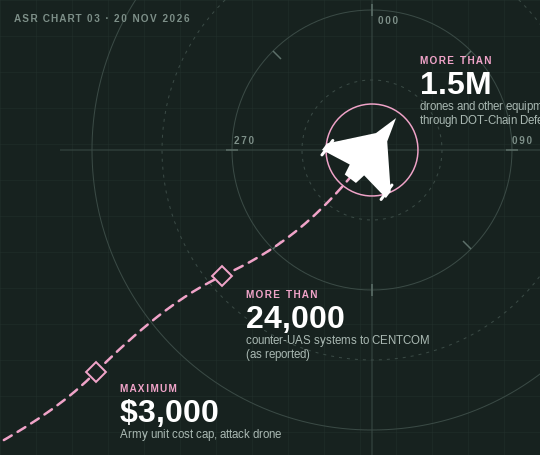
Ukraine destroyed a record 1,704 Shahed-type drones in January 2026, roughly 70 percent of them by interceptor drones rather than by guns or missiles, on figures originating with The Economist.63 Zelensky said on January 20, 2026 that Ukraine was producing up to 1,000 interceptors per day.64 Zelensky had reported in June 2025 that roughly one third of Shaheds were being destroyed by mobile fire groups, with interceptor drones then entering service from four manufacturers. The move from truck-mounted machine guns to a purpose-built drone-against-drone layer took about seven months.
The Wild Hornets Sting became the reference platform. Reported unit cost runs from roughly $1,400 at the low end to $2,100 or $2,500 in other accounts. Top speed is 315 to 343 km/h, with a cruise altitude around 3,000 m, thermal camera guidance, and terminal guidance that continues an intercept through jamming. It achieved the first interceptor drone kill of a jet-powered Geran-3 on November 30, 2025, and in April 2026 downed two Shahed-type drones with the operator working 500 km from the launch point.65, 66 The full defensive kill chain is covered at Countering the Shahed-136.
Interceptor Speed Against Threat Speed
A 343 km/h interceptor has roughly 160 km/h of margin over a piston Geran-2 and can convert that into a tail chase. That geometry is what made a few thousand dollars of quadcopter a credible answer to a $40,000 drone. Against a Geran-4 the margin is negative. The chart below places the fielded interceptor band against the threat bands on one speed axis; the table carries the same figures.
| System | Cruise speed | Intercept geometry available to a 343 km/h drone |
|---|---|---|
| Geran-2, piston | ~185 km/h | Tail chase, with margin to reattack after a miss |
| Geran-3, observed | 300 to 370 km/h | Marginal. Tail chase only at the low end, no second attempt |
| Geran-4 | 400 to 500 km/h | Forward-quarter cue only, one pass, requires earlier detection |
| Geran-5 | 450 to 650 km/h | None available to this interceptor class |
| Wild Hornets Sting | 315 to 343 km/h | Reference interceptor, $1,400 to $2,500 per unit |
Autonomy in the Defensive Loop
A Brave1-developed autonomous interceptor destroyed a Shahed in Kharkiv Oblast on June 8, 2026 under active electronic warfare conditions, automating roughly 95 percent of the engagement and requiring one operator authorization. Ukraine's Defense AI Center confirmed operational deployment of computer-vision terminal guidance that functions when conventional datalinks are severed.4
Operator throughput is the binding constraint, and Ukraine has said so directly. Announcing production of up to 1,000 interceptors per day in January 2026, Zelensky identified the shortage as crews rather than airframes.64 A salvo of 500 drones saturates the number of trained pilots available to fly intercepts long before it saturates the number of airframes on the shelf, so automating the engagement is what converts stockpiled interceptors into delivered intercepts. Ukraine's 190th Training Center released interceptor training footage in May 2026 describing the first institutionalized program for remote destruction of Shaheds, and Ukrainian specialists transferred those procedures to United States forces in the Arabian Gulf in March 2026. Ukraine deployed counter-drone teams to the United Arab Emirates, Saudi Arabia, Qatar, Kuwait and Jordan in the same month.65 The lessons of the Ukrainian air defense are now an export.
Interception Rate Measurement
Interception of Shahed-type drones fell from 96.58 percent in January 2025 to 82.7 percent in December 2025, then recovered as the interceptor layer scaled. Ukraine's Ministry of Defence reported 89.9 percent of Russian missiles and drones intercepted or suppressed in March 2026, and interception of conventional piston Shaheds reached 96 percent in some mid-2026 periods.18 Reconstructed accounting for July 2026 gives 90.21 percent, which the analysis labels an interception-equivalent accounting rate rather than an observed kinetic kill rate, because unresolved vehicles are assigned to the interception column.4
Those figures are four separate series rather than four points on one curve. They differ in denominator, in weapon population and in what counts as a defensive success, and the 90.21 percent accounting rate explicitly assigns unresolved vehicles to the interception column. Connecting them grammatically would produce a decline-and-recovery curve that no single methodology supports. The direction is nonetheless clear in a quantity that is measured consistently: hit rates fell even as volumes rose, reaching roughly 6.65 percent of all Shahed-type UAVs in May 2026, about 10.48 percent of estimated strike Gerans, and rebounding to about 8 percent in June.4 A weapon that lands one time in ten is not a precision system, and the campaign works by launching enough of them that one in ten is sufficient. The aggregate 6.65 percent figure is the wrong denominator for judging attacker economics, because it counts decoys that were never meant to hit anything and that earn their cost by drawing radar activation, interceptors and operator attention.
Cost Comparison
The standard comparison sets an estimated Shahed cost of $20,000 to $50,000 against roughly $4 million for a Patriot interceptor, which makes one interceptor worth more than 100 drones at a midrange estimate.35 Ukraine has published a more useful figure, because it counts shots per kill rather than unit prices. Zelensky put an interceptor drone at $3,000 to $5,000 and the cost of destroying one Shahed at about $10,000, against $4 million for a Patriot round, and framed the gap as an exportable method: "Ukraine spends $10,000 to shoot down a drone, while a Middle Eastern country spends $4 million."67 The Pentagon has moved to buy into that method, examining Ukrainian interceptors in the $1,000 class in March 2026.68 A separate calculation put the cost to Russia at roughly $350,000 per target struck against roughly $1 million per target for its most cost-effective missile.
Two qualifications belong with those figures. Interception cost is not interceptor price: sensors, aircraft, command networks, crews and sustained readiness all sit inside the real cost of defended airspace, and a country that already operates that architecture pays much of it whether or not a drone is launched. And a multimillion-dollar interceptor is the correct choice against a drone seconds away from a transformer, a reactor building, a command post or a full apartment block, where the cost of letting it through exceeds any interceptor price.
What survives those qualifications is a narrower proposition and a harder one. Expensive interceptors have to be reserved for cases where cheaper layers cannot generate sufficient probability of kill, which requires the cheaper layers to exist, to be produced at rates matching the threat, and to be effective against the threat as it is now rather than as it was. The first two conditions Ukraine met during 2025 and 2026. The third is what the jet transition puts back in question.
Ukrainian industry has responded with faster designs, including first-person-view interceptors above 370 km/h and dedicated jet-powered counter-drones. The Defense Forces took the Alexa Spatium turbojet interceptor into service on 21 August 2026, the first Ukrainian jet-powered interceptor to be codified, with a composite airframe roughly 1.5 by 1.7 m, dual television and infrared guidance, mobile catapult launch, selectable fragmentation, shaped-charge or thermobaric warheads, and a return-to-base capability if it does not engage. Its stated targets are the Geran-3, Geran-4, Geran-5 and Shahed-131.69, 70 Firebolt Engineering's Griffen logged a jet-on-jet drone interception in early July 2026.12 No performance figures for the Alexa Spatium have been published by its manufacturer, and speed figures circulating for it in secondary coverage belong to a different system.
The unresolved question is unit economics rather than capability. Jet variants are not uninterceptable. Ukraine reported shooting down or suppressing more than 70 of 76 jet-powered Shahed-type drones launched in a single daytime attack on 18 August 2026, though the report does not say which systems made those kills, so it cannot be read as cheap-interceptor performance.71 A turbojet interceptor with a thermal seeker will catch a Geran-4. Whether it can be built for a few thousand dollars and fielded at the roughly 1,000 per day Ukraine reached with propeller designs is a different problem, and if the answer is no, then the defender is back to spending more per engagement than the attacker spends per sortie. That is the position Ukraine escaped in 2025, and it is the position the jet transition is designed to restore.
Proliferation of the Concept
The FLM-136 Low-cost Uncrewed Combat Attack System is a reverse-engineered derivative of captured Iranian hardware, roughly 3.0 m long with a 2.4 m wingspan, powered by a two-cylinder engine chosen partly for a lower acoustic signature than the four-cylinder Limbach copy in the Shahed. It carries an 18 kg payload to roughly 800 km at about 55 knots, at a unit cost near $35,000. CENTCOM established Task Force Scorpion Strike in December 2025 as the first dedicated United States one-way attack drone unit, and a LUCAS was launched from the flight deck of the littoral combat ship USS Santa Barbara using rocket-assisted takeoff on December 16, 2025. First combat use came on February 28, 2026 in the opening salvos of Operation Epic Fury.72, 73, 74 The program is profiled at LUCAS.
Shield AI's Hivemind autonomy software is being integrated into the fleet, giving onboard navigation, obstacle avoidance and inter-drone task sharing over a satellite-relay mesh so that one operator can direct a wave rather than a single airframe.75 CENTCOM established Task Force Falcon Strike in August 2026 as a multinational successor, integrating aerial, surface and, in its stated scope, underwater uncrewed systems alongside regional partners.76 The Pentagon directive that started this reached combat deployment in under eight months, which is an acquisition interval the United States has not achieved on a conventional munition in decades.
Commercial Dependencies in the Cost Model
After the February bombing campaign began, SpaceX executives argued to Pentagon officials that LUCAS operations warranted the aviation-tier Starlink subscription at $25,000 per terminal per month rather than the $5,000 rate then being paid. Pentagon officials countered that the aviation tier was built for crewed aircraft needing continuous connectivity rather than for expendable drones taking guidance updates. The Pentagon accepted the increase, which roughly doubled the effective per-unit cost of a drone priced at about $35,000.77, 78
The finding generalizes past this program. Affordable mass assembled from commercial services carries the pricing of those services inside its cost model, and a single-vendor dependency lets the vendor reprice the weapon in the middle of a campaign. Russia met a version of the same problem from the other direction when SpaceX geofencing and whitelist enforcement disrupted its own use of Starlink on strike drones.
Non-State Operators and Indigenous Programs
Houthi forces operate Shahed-family systems under the Waid-1 and Waid-2 designations against Red Sea shipping and Israel, drawing on the same Chinese engine supply chains as Iran and Russia. In Sudan, humanitarian imagery analysis documented Shahed-136-style delta-wing airframes and pneumatic launch platforms at Rapid Support Forces-controlled Nyala airport, with 13 airframes and 16 launch platforms visible in imagery from May 1 to 6, 2025, coinciding with long-range strikes on Port Sudan roughly 1,600 km away, and at least 43 airframes by September 29, 2025. Conflict monitoring attributed at least 2,200 deaths to drone attacks in Sudan, about 80 percent of them during 2025.
Attribution caution applies to that evidence. Delta-wing airframes resembling the Shahed-136 include Iranian derivatives, Russian Geran variants, decoys and unrelated designs, and the Sudan airframes were assessed as consistent with Shahed-136-style loitering munitions rather than confirmed as Shahed-136s. A silhouette supports a class identification and not a model identification.1
A different kind of proliferation matters more for the next decade. Saudi Arabia's SR2Vector joint venture began building a production facility near Riyadh around May 2026 for the SkyWasp, a one-way attack drone with a delta-wing pusher-propeller layout, approximately 1,500 km range and anti-jam satellite navigation, optimized for scalable saturation rather than high precision. Turkey's STM unveiled the Kuzgun in May 2026: runway-independent, more than 1,000 km range, a 200 kg class airframe with an approximately 40 kg warhead, six-hour endurance and an autonomous terminal dive. Thailand fielded the battery-electric KB-5E, and India flight-tested the jet-powered Divyastra Mk3 in August 2026.12
None of those is a Shahed export. They are national programs built because the economic logic of the design became visible in two theaters, and they represent a harder proliferation problem than airframe transfer, because there is no shipment to interdict and no supplier to sanction. Interdicting engines and antennas can slow one production line. It cannot un-demonstrate that a delta wing, a small piston engine and a satellite receiver will reach 1,500 km with a 50 kg warhead for the price of a used car.
Variant Reference
| Variant | Origin | Key differentiators | Status |
|---|---|---|---|
| Shahed-136 | Iran | Baseline delta wing, MD-550 piston, satellite navigation to preset coordinates | Operational |
| Geran-2 | Russia | Russian production, Kometa CRPA navigation, diversified warheads to 90 kg | Operational |
| Geran-2 MS001 | Russia | Infrared camera, video capture, onboard computing | Documented June 2025 |
| Geran-2, air-to-air | Russia | R-60 on an aviation rail or a Verba MANPADS, dual cameras, mesh modem, no strike warhead | Documented December 2025 and January 2026 |
| Geran-3 / Shahed-238 | Russia and Iran | Tolou-class turbojet, 300 to 370 km/h observed, reused piston-era airframe | Largely phased out mid-2026 |
| Geran-4 | Russia | Chinese Telefly turbojet, 400 to 500 km/h, reinforced airframe, 450 to 850 km | Operational since May 2026 |
| Geran-5 | Russia | Cruise-missile fuselage, 90 kg warhead, 900 to 1,000 km, Su-25 air-launch reported | Operational since January 2026 |
| Gerbera | Russia | Foam and plywood, radar reflectors, decoy or ~5 kg warhead, also a mesh relay node | Operational, not a Shahed-136 variant |
| Italmas (BM-35) | Russia | ~200 km, 15 to 40 kg warhead, radar-evasion optimized, jet retrofit reported August 2026 | Operational |
| Shahed-101 | Iran | Nose-mounted electric propulsion with rocket booster, acoustic and infrared signature reduction | Fielded March 2026 |
| LUCAS / FLM-136 | United States | ~$35,000, 18 kg payload, ~800 km, Starlink datalink, Hivemind autonomy | Operational |
Assessment
The Shahed-136 should no longer be monitored as a fixed Iranian drone model. The relevant object is a production and operational ecosystem built on an inexpensive delta-wing airframe and now diversified across propulsion, payload, navigation, sensing, communications, launch geography and tactics. Russia's industrial expansion through 2025 and Iran's theater-scale employment through 2026 established the concept as a durable long-range strike capability whose effectiveness comes from repeated adaptation at volume rather than from the performance of any single airframe.
Strategic attrition from this weapon is real and measurable. Ukrainian civilian deaths from long-range weapons rose 65 percent in 2025, the energy grid absorbed eight coordinated wave attacks in two months, more than 200 locomotives were damaged or destroyed in six months, and Gulf and United States interceptor stockpiles were drawn down past half in weeks. Strategic coercion is a separate question and remains unproven rather than disproven. Neither Ukraine's war aims nor Gulf alignment shifted under drone pressure during the period covered here, and the campaign continues.
The decisive near-term variable is whether jet-capable interception can be produced at the unit cost and daily rate that propeller interception reached. Ukraine closed the cost-exchange gap in 2025 and 2026 by driving the cost of destroying one Shahed to about $10,000, against roughly $4 million for a Patriot round, at production reaching 1,000 interceptors per day. A 3,000-per-month jet production run at Yelabuga is a deliberate move to reopen that gap, and it targets the geometry the cheap answer depends on rather than the answer itself.
Two developments deserve monitoring above the rest. Wreckage from Gulf strikes compared against Russian Geran component architecture would establish how far the reverse transfer of navigation and electronic warfare hardware has gone, which determines whether Iranian mass attack becomes as jam-resistant as Russian mass attack. And the appearance of a jet-capable interceptor with a published unit cost under $10,000 would indicate the defensive economics can be rebuilt at the new speed band. Absent the second, defenders return to spending more per engagement than the attacker spends per sortie.
Related Research
- Countering the Shahed-136: the defensive kill chain in detail, including sensor-layer performance, cost per engagement, and the operational record of each defeat mechanism.
- Geran-4: full performance treatment of the jet variant now leading Russian production, including engine sourcing and engagement-window arithmetic.
- LUCAS: the United States reverse-engineered derivative, its acquisition timeline and its combat debut in Operation Epic Fury.
- Iran Drone TTPs and Hardware Catalog: the wider Iranian inventory and employment doctrine behind the Gulf campaign described above.
Sources
- Open Source Munitions Portal, "Shahed-131 & -136 UAVs: a visual guide," Open Source Munitions Portal, 2026. Link
- Institute for Science and International Security, "A Comprehensive Analytical Review of Russian Shahed-type UAVs Deployment against Ukraine in 2025," Institute for Science and International Security, 2026. Link
- War on the Rocks, "Drones, Discord, and the Shifting Front in Ukraine," War on the Rocks, August 16, 2025. Link
- Igor Anokhin, "Monthly Analysis of Russian Shahed 136 Deployment Against Ukraine, Updated," Institute for Science and International Security, August 10, 2026. Link
- Euromaidan Press, "Tanks hide, evacuations take days, and drones cause 80% of casualties: how Ukraine's war transformed in 4 years," Euromaidan Press, February 24, 2026. Link
- Euromaidan Press, "The numbers behind Ukraine's worst winter since the full-scale invasion: 19,000 drones, 14,670 bombs, 738 missiles," Euromaidan Press, March 1, 2026. Link
- CNN, "Zelensky vows response after Russian strike on shopping mall kills 16," CNN, August 21, 2026. Link
- Kyiv Independent, "Russian double-tap strike on shopping center in Kryvyi Rih kills at least 16, injures 130," Kyiv Independent, August 21, 2026. Link
- Al Jazeera, "Russian drone attack on busy shopping centre kills 15 in Ukraine," Al Jazeera, August 21, 2026. Link
- Militarnyi, "Russia Produces Around 3,000 Geran-4/5 Kamikaze Drones per Month," Militarnyi, August 12, 2026. Link
- Kyiv Post, "Russia Produces 3,000 Geran-4/5 Attack Drones Each Month, Ukraine's Intelligence Says," Kyiv Post, August 12, 2026. Link
- Kyiv Independent, "As Russia turns to jet-powered drones, Ukraine scrambles for new interceptor tech," Kyiv Independent, 2026. Link
- The War Zone, "Russia Is Expanding Its Long-Range Strike Drone Network," The War Zone, 2026. Link
- Euromaidan Press, "Russia's Shahed drone upgrades: Armor, bombs, and tactics," Euromaidan Press, June 30, 2025. Link
- Euromaidan Press, "Russia built an invisible web of Shahed relay towers in Belarus; Ukraine just tore it down," Euromaidan Press, February 27, 2026. Link
- Euromaidan Press, "Russo-Ukrainian war, day 1460: Ukrainian hackers watched Russian drone operators plan strikes for six months," Euromaidan Press, February 22, 2026. Link
- Euromaidan Press, "Ukraine promises further actions against Belarus for drone relays," Euromaidan Press, February 23, 2026. Link
- Euromaidan Press, "How Starlink made Russia's drones deadlier and harder to jam," Euromaidan Press, February 3, 2026. Link
- Kyiv Post, "Ukraine Introduces Starlink Verification to Counter Russian Drone Attacks," Kyiv Post, 2026. Link
- Jamestown Foundation, "Ukraine Responds to Russia's Starlink Use," Jamestown Foundation, 2026. Link
- Ukrainska Pravda, "Russia equips Shahed drones with Starlink, increasing their danger, Defense Express," Ukrainska Pravda, September 26, 2024. Link
- Defense Express, "Exclusive: Russians Arm Shahed-136 With New 90-kg Combined-Action Warheads," Defense Express, May 20, 2025. Link
- United24 Media, "Russia Upgrades Shahed Drone With New Fuselage to Mount R-60 Air-to-Air Missiles," United24 Media, 2026. Link
- Security Service of Ukraine, "SSU detects elevated radiation levels on wreckage of russian strike drone used to attack Chernihiv region in April 2026," Security Service of Ukraine, May 20, 2026. Link
- Defense Express, "Ukraine Reports Elevated Radiation in R-60 Missile Fragments Mounted on russian Geran-2 Drone," Defense Express, 2026. Link
- Militarnyi, "SSU Records Elevated Radiation in Geran-2 Wreckage Linked to R-60 Missile," Militarnyi, 2026. Link
- Interfax-Ukraine, "SBU uncovers 6 more instances of Russia using depleted uranium munitions in Chernihiv region," Interfax-Ukraine, July 23, 2026. Link
- Ukrinform, "SSU documents new cases of Russia using depleted uranium munitions," Ukrinform, July 23, 2026. Link
- CSIS Beyond Parallel, "A Closer Look at the Yelabuga UAV Factory," Center for Strategic and International Studies, March 17, 2026. Link
- FlightGlobal, "Russia scales Yelabuga UAV facility to 116 buildings," FlightGlobal, March 2026. Link
- Institute for Science and International Security, "Satellite Imagery Update on Alabuga Shahed-136 Drone Factory," Institute for Science and International Security, 2025. Link
- Foreign, Commonwealth and Development Office, "List of Russia and irregular migration sanctions designations, 5 May 2026," GOV.UK, May 5, 2026. Link
- Iran Watch, "Victory and Profit: Shahed Drone Engines, Chinese Entrepreneurs, and the Pitfalls of AI-Driven Marketing," Iran Watch, 2026. Link
- The War Zone, "Ukraine Sinks Russian Cargo Ship In Caspian Sea," The War Zone, August 16, 2025. Link
- Reuters, "Factbox: US deploys suicide drones and Tomahawk missiles in Iran strikes," Reuters, March 1, 2026. Link
- South China Morning Post, "Missiles streak across Gulf skies as Iran responds to US-Israel attack," South China Morning Post, February 28, 2026. Link
- Breaking Defense, "'Nightmare scenario' for GCC countries, region as Iran unloads drones and missiles," Breaking Defense, March 1, 2026. Link
- Defence Blog, "Iranian drone strikes Kuwait International Airport," Defence Blog, February 28, 2026. Link
- Defence Blog, "Iran targets U.S. naval base radar with Shahed drone," Defence Blog, February 28, 2026. Link
- The War Zone, "Images Show E-3 Sentry Totally Destroyed From Iranian Strike," The War Zone, March 2026. Link
- Military Times, "US F-15E fighter jet shot down over Iran," Military Times, April 3, 2026. Link
- Air and Space Forces Magazine, "F-15E Aviator Missing in Iran Rescued by US Forces," Air and Space Forces Magazine, April 2026. Link
- Defense One, "Shahed drone meets clone in US war on Iran," Defense One, February 2026. Link
- Air and Space Forces Magazine, "Air Force Creating New Job Specialty in Base Air Defense," Air and Space Forces Magazine, June 26, 2026. Link
- Marcel Plichta, "Fences Not F-35s: Drone Attacks and the Illogic of Gulf Procurement," War on the Rocks, June 4, 2026. Link
- Defense One, "Fighter jets are downing Iranian drones: a dangerous, expensive mission," Defense One, March 2026. Link
- United24 Media, "Iran's Shahed Drone That Hit UK Base Includes Russian Kometa-M Technology," United24 Media, March 2026. Link
- Ukrainska Pravda, "Shahed drone that hit UK air base in Cyprus may have carried Russian Kometa-M receiver," Ukrainska Pravda, March 3, 2026. Link
- Quwa, "Russian Drone Parts Found in Iranian Shahed That Hit RAF Akrotiri," Quwa, 2026. Link
- Defence Security Asia, "Russia's Secret Hand in Iran's Drone War: U.S. Probes Kometa-M Tech Behind CIA Station Strikes in Riyadh," Defence Security Asia, 2026. Link
- Army Recognition, "Russia Supplied Upgraded Shahed Kamikaze Drones to Iran for Attacks on U.S. Forces," Army Recognition, March 2026. Link
- AeroTime, "Russia denies sending modified Shahed drones to Iran," AeroTime, March 2026. Link
- Euromaidan Press, "Romania's forensic report confirms the Galati drone was a Russian Geran-2," Euromaidan Press, May 31, 2026. Link
- Ukrinform, "Romania confirms residential building was struck by Russian Geran-2 drone," Ukrinform, 2026. Link
- Militarnyi, "Investigation Confirms Russian Geran-2 Drone Hit High-Rise Residential Building in Romania," Militarnyi, 2026. Link
- Al Jazeera, "NATO jets shoot down drone over Latvia, extending Ukraine spillover fears," Al Jazeera, June 8, 2026. Link
- CNBC, "NATO fighter jets shoot down drone over Latvia," CNBC, August 14, 2026. Link
- ABC News Australia, "NATO fighter jet shoots down a drone over Latvia," ABC News, August 14, 2026. Link
- The Aviationist, "Iranian Drone Took Out U.S. Apache Downed in the Strait of Hormuz," The Aviationist, June 9, 2026. Link
- CNN, "Crew members safe after Trump says Iran shot down US helicopter," CNN, June 9, 2026. Link
- The War Zone, "AH-64 Apache Shot Down By Iran, U.S. Will Retaliate: Trump," The War Zone, June 2026. Link
- Defense Express, "How a Shahed Drone May Have Brought Down an AH-64 Apache in One of the First Such Cases Ever Recorded," Defense Express, June 2026. Link
- Haye Kesteloo, "Ukraine Is Scaling Up Interceptor Drones as Russia's Shahed Threat Outpaces Every Defense," DroneXL, March 1, 2026. Link
- Tetiana Lanchukovska, "Ukraine produces up to 1000 interceptors per day, but there are not enough operators," LIGA.net, January 20, 2026. Link
- Al Jazeera, "What are the Ukrainian drone interceptors sent to counter Iranian attacks?," Al Jazeera, March 10, 2026. Link
- Ukrainska Pravda, "Shahed-type drones downed by Ukrainian STING interceptors from 500 km away," Ukrainska Pravda, April 4, 2026. Link
- Svitlana Neschetna, "1,000 drones a day: Zelenskyy warns of Russia's new strategy, names cost of intercepting targets," TSN, 2026. Link
- Military Times, "These are Ukraine's $1,000 interceptor drones the Pentagon wants to buy," Military Times, March 11, 2026. Link
- Militarnyi, "Alexa Spatium Jet Interceptor Enters Ukrainian Defense Forces Service," Militarnyi, August 21, 2026. Link
- United24 Media, "Ukraine's First Jet Interceptor Enters Service, What Russian Drones Will It Destroy?," United24 Media, August 21, 2026. Link
- Ukrainska Pravda, "Russia has launched 76 jet-powered Shahed-type drones on Ukraine in one day," Ukrainska Pravda, August 18, 2026. Link
- The War Zone, "U.S. Military Has Used Long-Range Kamikaze Drones In Combat For The First Time," The War Zone, February 28, 2026. Link
- Defense News, "US confirms first combat use of LUCAS one-way attack drone in Iran strikes," Defense News, February 28, 2026. Link
- DefenseScoop, "After first combat appearance, LUCAS drones 'remain ready' for future operations," DefenseScoop, March 2, 2026. Link
- The War Zone, "U.S. Military's LUCAS Kamikaze Drone Is Getting Hivemind Swarming Capability," The War Zone, 2026. Link
- The War Zone, "U.S. Launching International One-Way Attack Drone Task Force In The Middle East," The War Zone, August 2026. Link
- Army Times, "Pentagon spars with SpaceX over Starlink price hike during Iran war," Army Times, May 26, 2026. Link
- The War Zone, "Cost To Link LUCAS Kamikaze Drones To Starlink Highlights Pentagon's Ever-Growing Dependence On SpaceX," The War Zone, May 2026. Link
Analysis by drone-warfare.com | Last Updated August 23, 2026
This Post Has 4 Comments
Comments are closed.
Pingback: فيديو يُنسب لإطلاق صواريخ كروز حوثية نحو البحر الأحمر.. ما حقيقته؟ - sidqyem
Pingback: Drony „Geran“ zničili náklad NATO na Dunaji. – PrávoDnes
Pingback: The Incredible Shrinking Superpower – MicroVibeNews
Pingback: The Complex Web of Russian and Chinese Involvement in the GCC-Iran Conflict – Royce de Melo